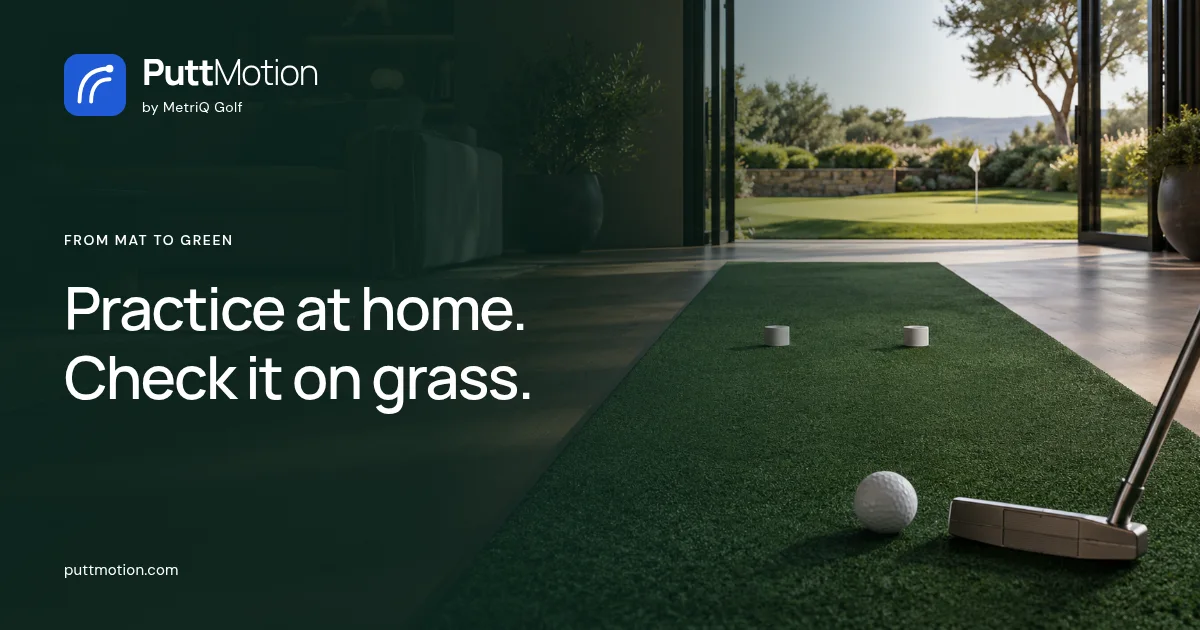
Use a flat mat to practice sending the ball through a chosen starting window. Keep the setup repeatable, record gate contacts separately and do not treat a pass as a face-angle measurement. On grass, check the same starting task before adding the reads and pace decisions that the green requires.
A run of putts into the cup on your indoor mat can feel reassuring. Then you get to the practice green and the ball stops short or curves away from the hole. It is tempting to wonder whether the time at home helped at all.
If you are looking for a putting app to support practice at home, start with what the mat lets you practice. You can work on sending the ball through a chosen starting window. The green adds decisions about line and pace on another surface, often with a slope. Take the starting-direction task outdoors before judging the whole putt.
Give the mat one clear job
For this session, focus on the beginning of the roll. A small gate gives you something more specific to observe than whether the ball eventually drops into the mat’s cup. Did it travel through the gap you chose?
Use a flat section of mat on a firm, level floor. Smooth out wrinkles and choose a starting spot and a target within that flat section, away from a raised cup or ball-return ramp. Decide how you want the ball to arrive at the target rather than simply hitting it hard enough to clear the gate.
If your mat ends in a raised cup, holing the ball also requires getting it up that ramp. Keeping the target on the flat section avoids making the ramp part of this task. Even there, the pace you choose belongs to this surface; it does not tell you how hard to hit the same-length putt on a green.
Set up a gate you can repeat
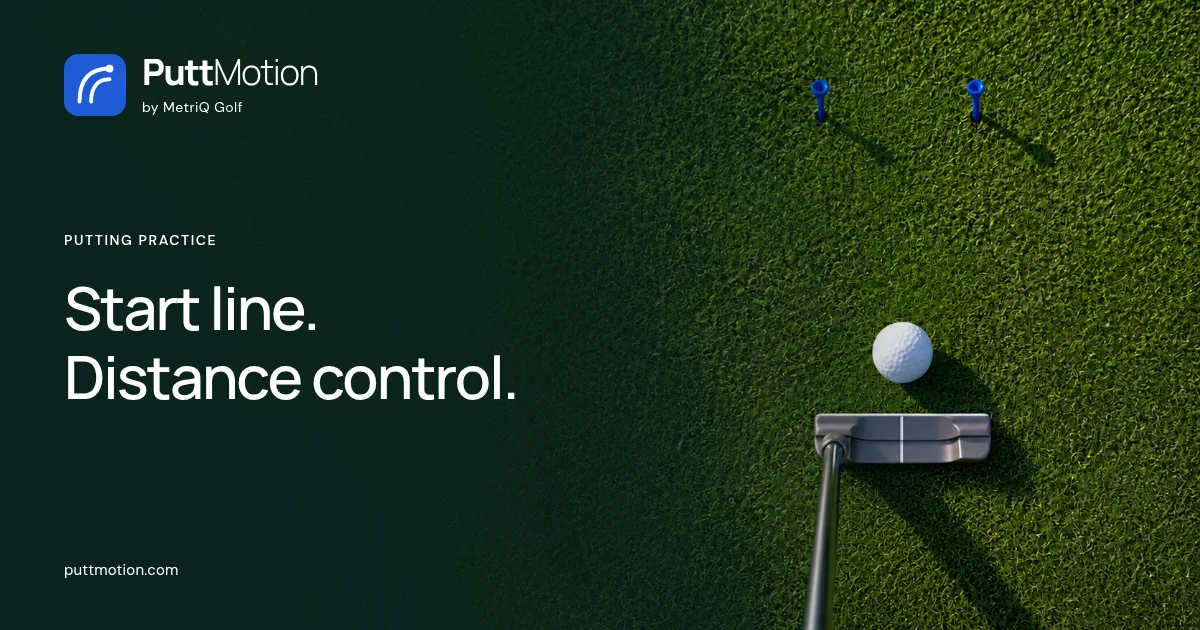
Place two small markers on either side of your intended starting line, a short distance ahead of the ball. Leave a gap wider than the ball, with some clearance, and keep the intended roll clear. Do not lay anything across its path.
Write down the gap’s inside width and its distance from the starting spot so you can rebuild the setup. Choose dimensions that suit your space; there is no universal gate size here. Moving it farther away or narrowing it changes the task.
Try a short set with the same setup. On paper, note a clean pass, a miss to either side or an unclear attempt. If the ball touches a marker, record the contact; the collision can change its speed and direction, so do not use the remaining roll to judge the pace of the original putt.
Notice what the mat supplies
If the mat has a printed guide, it supplies a visual reference for the starting direction. Removing the gate does not remove that help. Note whether you used the guide: passing through the same opening on grass without it is a different challenge. Choosing a line on grass is another task, beyond following one at home.
A clean pass tells you that the ball passed through that opening. It does not measure face angle or putter path, or diagnose the stroke. Keep your conclusion as specific as your observation.
Give the app a supporting role
An indoor drill in a putting app should make its task clear enough for you to carry it out in the space you have. For this exercise, the useful feedback is simply what you observe at the gate.
PuttMotion is available on the App Store, with putting drills, camera analysis, green reading and round statistics. You can do the exercise here with a mat, a putter, a ball, two markers and paper.
Take the starting direction to a real green
On your next visit to a practice green, find a reasonably level short putt without getting in anyone’s way. Where practice markers are allowed, recreate your chosen gate width and distance from the ball. Choose the pace for this green rather than copying the stroke that reached your indoor target.
Watch the passage through the gate separately from where the ball finishes. You are checking whether you can send the ball through the same-sized opening on grass, not running a controlled test of improvement. A clean pass followed by a miss still leaves questions about pace, the chosen line and the surface; the gate cannot settle them.
Then remove the gate and move to putts with some slope. Read each putt, choose a starting direction and an intended pace, and watch the full roll. This is the part the flat mat could not give you: deciding how to send the ball toward the hole on the green in front of you.
Keep the indoor and outdoor observations separate. If the starting window is manageable at home but difficult on grass, that gives your next practice session a clear question. If it is manageable in both places, you still need to work on the reads and pace that the green demands. Indoor results alone do not establish better on-course putting.
Sources and references
- Take PuttMotion to the green ↗
- Park, Kim and Jung — A Study on the Goal Setting Method for Increasing the Holed Probability in Slope Putting Stroke on an Artificial Putting Surface (technical background, not evidence of training transfer) ↗