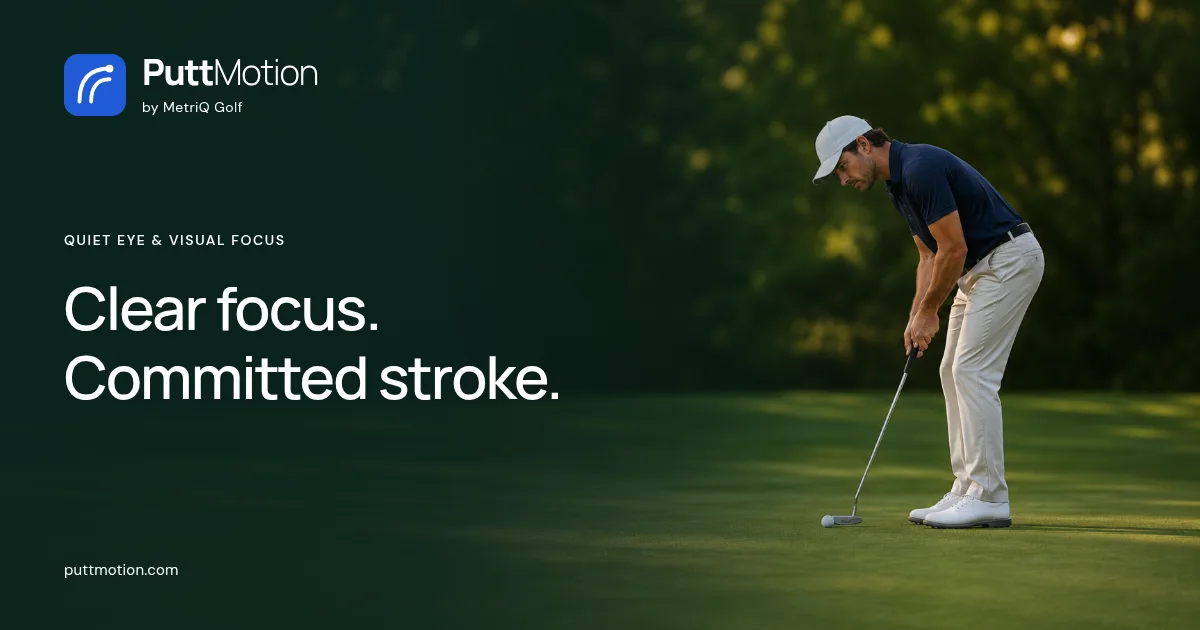
Quiet-eye practice gives your gaze a clear task before the stroke: settle on a spot on the ball and carry that visual intention into the putt. Record your impression separately from the ball’s result. Completing a focus exercise does not measure gaze or fixation duration.
Use a putting app’s quiet-eye exercise to practice a clear visual intention before the stroke. Decide on the putt, settle your gaze on a spot on the ball and make the stroke without chasing the clubhead with your eyes. Finishing the exercise does not, by itself, tell you how your eyes behaved during the putt.
That distinction matters to how I want you to use PuttMotion. Its quiet-eye focus tool gives visual preparation a place alongside putting drills. The useful goal is to carry a clear visual task into the next real putt.
What quiet eye means in putting
Quiet eye is a final steady gaze that starts before the stroke and may continue during it.
You can keep your head still while your eyes move. You can also look at the ball while your attention is occupied by something else. Neither a still head nor a feeling of concentration establishes a measured quiet-eye period.
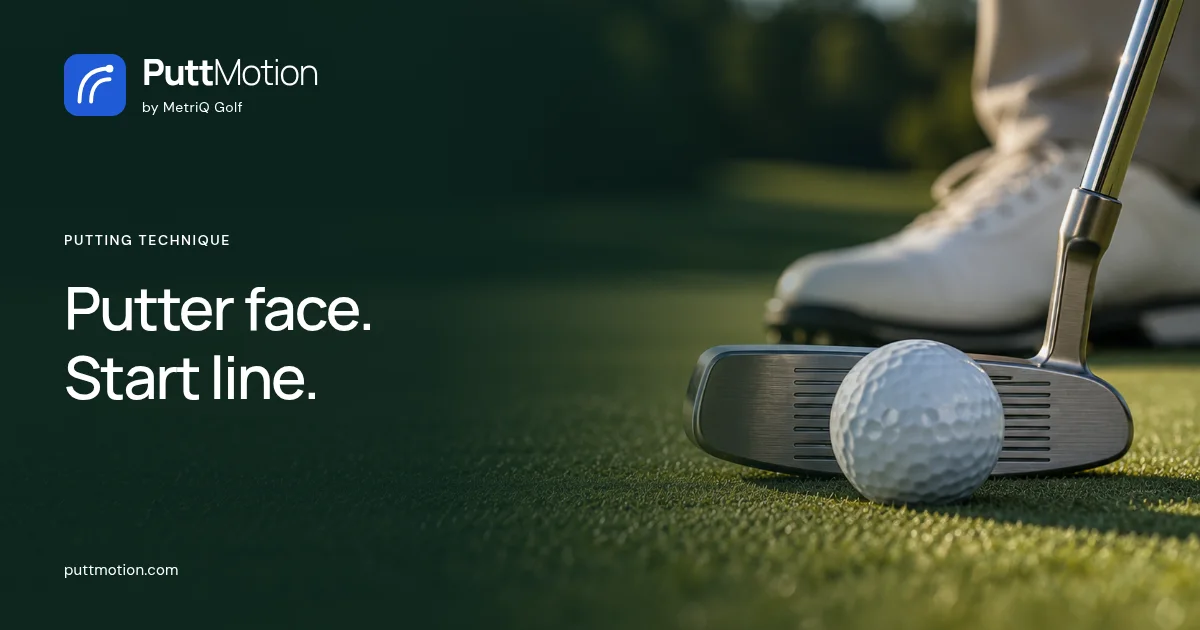
For practice, give yourself a visible reference: a small spot on the ball. Choose the read and intended pace first. If you are still changing the line at address, step back and finish that decision before trying to settle your gaze.
Take the focus from the exercise to the ball
Choose a straightforward putt on a quiet part of the practice green. Keep the starting point, target, ball and putter the same for a small set of attempts that you choose beforehand. This is an observation exercise, not a validated training protocol or a test with a required score.
Use the quiet-eye tool according to its instructions, then put the phone aside and give the real putt your attention. After your usual look at the target, return your gaze to the spot you selected on the ball. Begin the stroke intending to keep your gaze on that spot. The task is to avoid visually following the putter back, not to freeze your body or hold your breath.
Keep the exercise comfortable. Do not force your eyes open or turn it into a contest to stare for as long as possible. If the cue makes you tense or distracts you from the putt, pause and simplify it. A coach can help you find a cue that fits your routine.
After each attempt, make one brief note on paper. Choose the description that matches your experience: “I followed my visual intention,” “I noticed my attention shift,” or “I’m not sure.” These are your impressions, not eye-tracking data. It is fine not to be sure.
Keep the observation beside the result
Record whether the putt went in and where a miss finished separately from the focus note. A make does not confirm a good fixation, and a miss does not establish that your eyes moved too soon. Read, pace, contact and start direction still matter.
For example, imagine that you hole a putt but notice you watched the putter during the backswing. Keep the result and your impression in your notes. On the next attempt, you might maintain your intended visual reference and still miss. This hypothetical example is why the ball’s result should not rewrite your account of the process.
Review the notes after the set. If you repeatedly lost the reference because you were reconsidering the line, work on settling that decision. If the description is usually “not sure,” keep it that way. Measuring fixation duration requires an appropriate gaze-measurement method; an exercise timer or an ordinary video of the stroke cannot supply that measurement on its own.
Use research as a reason to explore
A small 2011 study found that guided gaze training helped skilled golfers under pressure. It used eye tracking, not PuttMotion.
That is a reason to take visual practice seriously, without borrowing a study’s outcome as your expected improvement. The group, task and training method matter. There is no universal number of seconds or guaranteed reduction in putts to take from this exercise.
For your next session, bring one question to PuttMotion’s quiet-eye practice: can I give my eyes a clear task and carry it into the stroke? Keep the observation honest, keep the putting result beside it and use what you notice to choose the next thing to practice.
Sources and references
- Vine, Moore and Wilson (2011) — Quiet Eye Training Facilitates Competitive Putting Performance in Elite Golfers ↗
- Apple — PuttMotion Golf on the App Store ↗