In a straight-path model, a one-degree starting error creates about 0.69 in of sideways difference after 3.28 ft along the intended line, and 2.06 in after 9.84 ft. This explains the scale of a direction error. It does not measure your putter face or predict whether a real putt will go in.
One degree sounds small. In a straight-line model, a ball starting one degree away from its intended direction is about 0.69 in off that line after traveling 3.28 ft forward. At 9.84 ft, the sideways difference is about 2.06 in. That is why a short putt can ask for more directional precision than it appears to.
I want a putting training app to help players understand what the ball did before deciding what to change. This simple demonstration connects a small direction error to the Gate Drill planned in PuttMotion.
A small angle creates a growing gap
Picture two straight lines leaving the center of the ball. One follows your intended starting direction. The other is rotated one degree to the right. The lines get farther apart as you move down the intended line.
- At 1.64 ft forward, the sideways difference is about 0.34 in.
- At 3.28 ft, it is about 0.69 in.
- At 6.56 ft, it is about 1.37 in.
- At 9.84 ft, it is about 2.06 in.
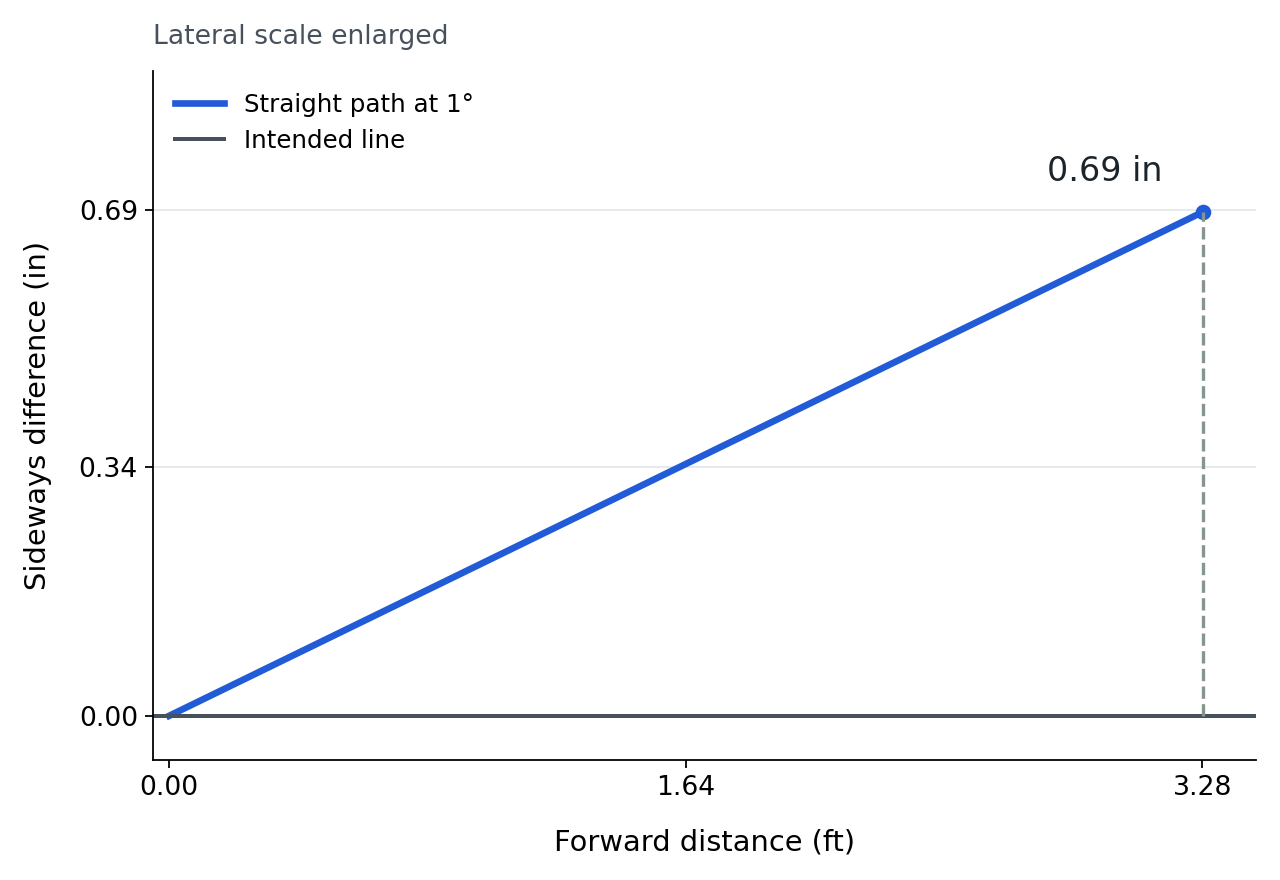
These are calculated examples, not measured putts or player results. They assume a straight path with no break. The distance is measured along the intended line and the sideways difference is measured at a right angle to it. The calculation is forward distance multiplied by the tangent of one degree.
A real green can curve the ball away from its initial direction. Pace also affects the line and whether a ball near the cup will drop. So the numbers explain the scale of a directional error; they do not predict whether a particular putt will go in.
Make one degree visible before hitting a putt
You can demonstrate the 3.28 ft example without a phone, a sensor or a stroke change.
- On a flat practice surface, mark a starting point and a center reference 3.28 ft ahead. Use a straightedge or tape measure to establish the intended line, then remove anything that would interfere with a ball.
- At the far reference, mark a second point 0.69 in to the right. Measure sideways, perpendicular to the intended line, rather than along a diagonal.
- From the starting point, compare the directions to the two marks. The directions are about one degree apart. The same construction works to the left.
This shows an angle between two aiming references. It does not show that your putter face is one degree open or that your ball actually launched at that angle. Keep the demonstration separate from a measurement of your stroke.
Use the gate to observe the ball
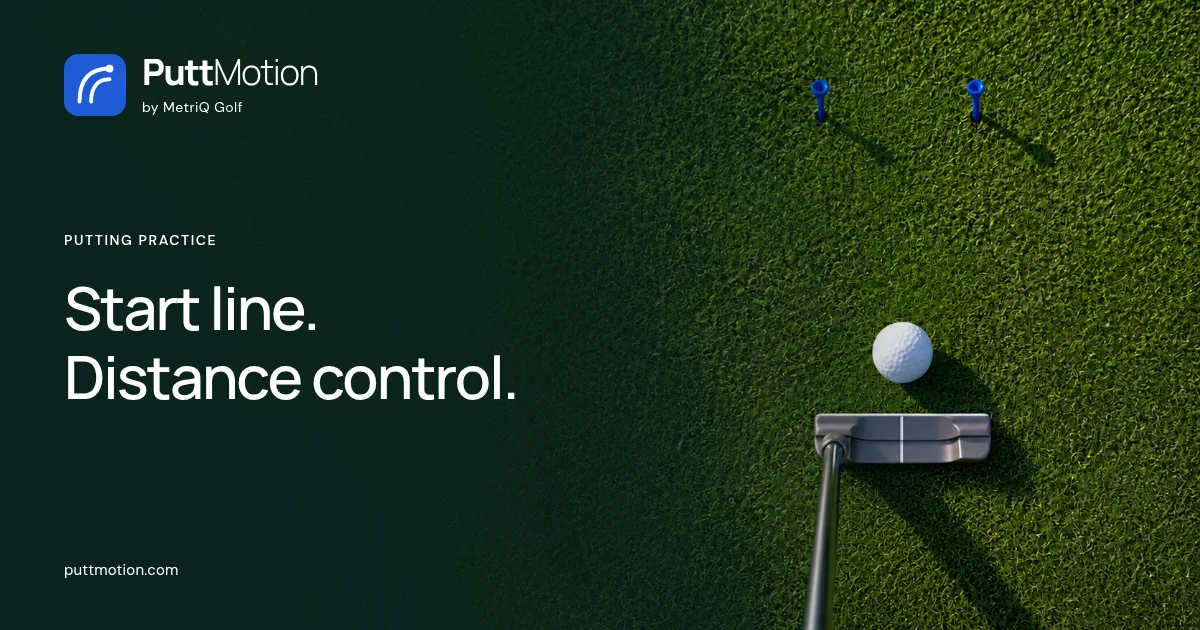
PuttMotion’s Gate Drill is a ten-putt exercise from 4 ft, with tees providing a starting-line reference. You can use that idea on a reasonably flat, straight practice putt now. Place a ball gate ahead of the starting spot, centered on your intended line. It is the ball that passes through; tees beside the putter head would test a different task.
Keep the starting spot, gate opening and gate distance fixed for the block. Choose the pace you would use to hole the putt and keep that intention throughout the set. Count a clean pass only when the ball clears both tees without contact, and note holed putts separately. The gate gives you a visible window for the ball’s path rather than an exact angle reading.
For example, in this straight-path model, a one-degree starting direction produces about 0.34 in of sideways displacement at a gate 1.64 ft away. Whether the ball clears it depends on the space available for the ball’s center. The opening alone is not an angle measurement.
Do not turn the ball result into a face angle diagnosis
Face orientation at impact strongly influences launch direction; club path and contact also matter. A collision with the right tee does not, by itself, show that you need to close the face. The ruler demonstration explains scale; a technical assessment investigates your delivery. Our guide to face angle and start line explains the distinction.
Turn the observation into the next practice task
If contact repeatedly occurs on one side after you check the setup, take that pattern to your coach. If the ball passes cleanly but misses the hole, consider pace and read alongside direction: a clean pass still allows some directional error. The useful next task depends on what you observed, rather than making the gate endlessly narrower.
PuttMotion is available on the App Store, with putting drills, camera analysis, green reading and round statistics. For this exercise, keep your observations in simple practice notes and use the gate as an observation tool.
Sources and references
- Take PuttMotion to the green ↗
- Swiss Golf — Putting Exercises with a purpose, pp. 3 and 7 ↗
- Trackman — Performance Putting: The evaluator (technical context) ↗