Face angle is where the putter face points, start line is the ball’s initial direction, path is the putter head’s movement and break is the ball’s curve on the green. Observe direction, contact and speed separately before changing your stroke.
A putt misses right. Was the face open? Did you aim right? Did the ball start exactly where you intended, then take more break than you expected? The result looks the same, but the next practice session should look different.
That is a useful starting point for PuttMotion: give putting practice a clearer purpose. Before changing a stroke, separate what you planned, what happened at impact and what the ball did afterward. Here is a practical way to work through it.
Four things worth separating
Face angle is the direction the putter face points. Distinguish its position at address from its position at impact, and always specify the reference: your intended start line, for example. A face aimed correctly at address can arrive differently at the ball.
Start line is the direction the ball initially travels. On a breaking putt, your intended start line usually points away from the hole. Sending the ball directly at the cup can be a mistake even with a clean strike.
Putter path describes the head’s movement. Its direction through impact is one part of that movement. A naturally arcing stroke does not automatically mean the ball will start offline.
Break is the ball’s sideways curve across the green. Slope and ball speed work together here. A successful read needs a speed intention as well as an initial direction.
Why the face matters, without a magic percentage
Trackman’s putting analysis identifies face angle at impact as the dominant influence on launch direction, with path also contributing. That is useful guidance; treating one fixed percentage as a rule for every putter and strike adds false precision.
Strike location matters too. Contact away from the sweet spot can affect distance and direction; SAM PuttLab’s technical manual discusses these effects. A putt that finishes short is therefore not enough evidence that the stroke was too small. Check contact before making the motion bigger.
Drill 1: Test the ball’s start line
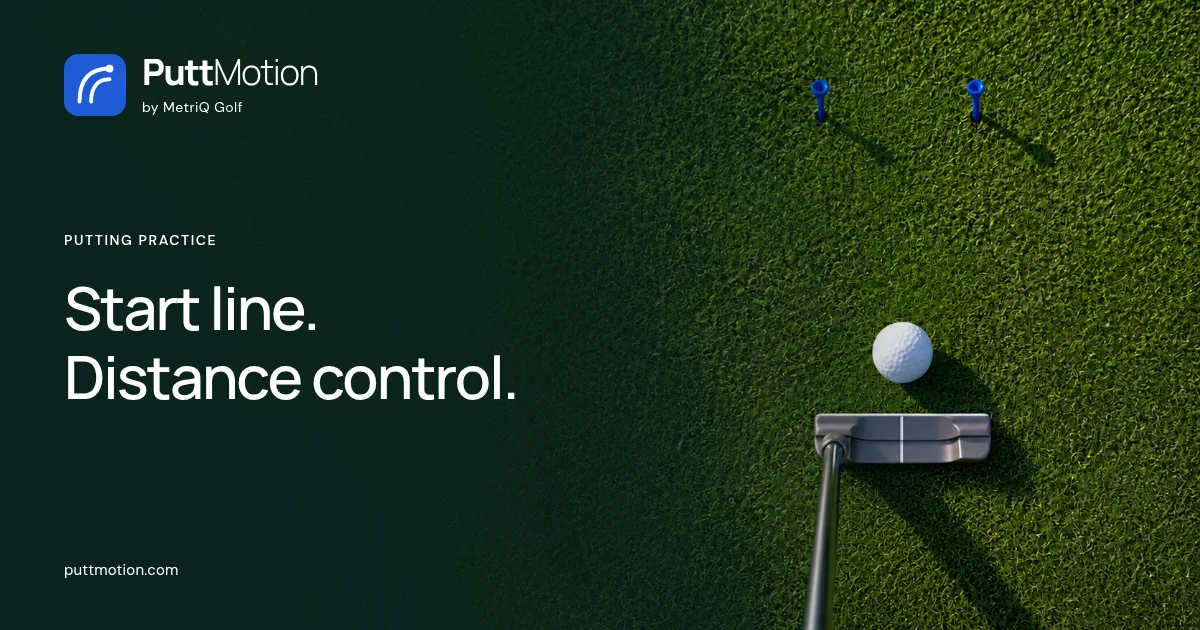
Find a reasonably flat, straight practice putt of about 6 ft. Place two tees about 1.7 ft in front of the ball, centered on your chosen start line. Leave a gap about half an inch wider than the ball. Use flat markers on an indoor mat.
Hit 10 putts with the same speed intention. Count gate passes and holed putts separately. A ball can pass the gate and still miss because of speed, a subtle slope or a poor read.
If you repeatedly clip one side, first recheck the gate and your aim. Then investigate delivery and contact. The gate shows initial-direction performance. A coach can help investigate the cause; measuring face angle precisely requires suitable equipment.
Drill 2: Check contact without forcing a straight stroke
From about 3 ft, set the putter behind the ball. Place a tee just outside the toe and another outside the heel, leaving roughly a quarter-inch clearance at each end. Keep the ball position consistent for 10 strokes.
Count clean passes, notice contact quality and watch the first part of the roll. If the putter keeps touching a tee, widen the gap slightly and rebuild repeatability. Do not steer the head along an artificial straight track throughout the stroke.
This putter gate and the first drill’s ball gate answer different questions. Passing between these tees does not prove that the face was square or that contact was centered. Together, the drills give you better clues about what deserves attention.
Drill 3: Pair the read with a speed
Choose a gentle breaking putt of about 10 ft. Mark your starting spot and pick an initial direction. Send three balls along that direction with a softer pace, then three with a firmer pace. Watch how the curve and finishing position change. Compare balls that started on your chosen line.
On a reasonably uniform slope, the firmer ball will generally take less break over the same forward distance. Real greens vary, so observe what happens rather than turning that expectation into a guarantee.
Now choose one pace, adjust the start line to match it and hit five more putts. Record whether each ball started where intended and whether it was holed. For misses, note short, long or unclear, and record left or right separately. Move to a different putt before repeating, so you also practice making a fresh prediction.
Turn the observations into your next session
Keep one distinction clear: tempo is the timing and rhythm of the stroke; ball speed is how fast the ball travels. A familiar rhythm can accompany different stroke lengths and distances. If you use a counting cue, keep it comfortable rather than chasing a universal beat.
PuttMotion is coming soon as a standalone app and within MetriQ. Its planned tools include drills, make percentage by distance, short/long miss analysis, putting Strokes Gained, slope and break-reading training, and tempo training.
The point of PuttMotion is to make the next practice decision more useful. Start with one question: did this putt need a different start line, better execution or a different speed? Work on that answer, then test it again.