Choose a short routine, observe the previous putt without diagnosing it from the result alone, and give the next ball a fresh read and intended pace. In a one-ball circuit, count every stroke and keep preparation notes separate from results. A made first putt has no follow-up routine to assess.
You miss a short putt, pull another ball into place and hit again before choosing a line. The next one may go in, but you have skipped the preparation you meant to practice. The useful question is what you do between those two attempts.
Try a session in which you keep the putting result and the preparation separate. You will still count every stroke. You will also notice whether a miss makes you rush, add extra rehearsals or change your plan while standing over the next ball.
Choose a short routine you can recognize
Write your sequence in a few words before starting. For example: read, choose pace and starting line, rehearse if that is part of your routine, set up, play. Use a sequence that fits your game rather than copying another golfer’s movements.
If you take a rehearsal stroke, connect it to the distance and pace of the putt ahead. Rehearse the putt you are about to play, rather than repeating the feel of the previous one. Keep the sequence familiar while adapting the read and intended pace to each new situation.
You do not need to time every movement or force the same number of seconds. For this exercise, the question is whether you made the decisions you intended to make. If you are interrupted or genuinely unsure of the line at address, step away and settle that decision before setting up again.
Give the previous putt a clear finish
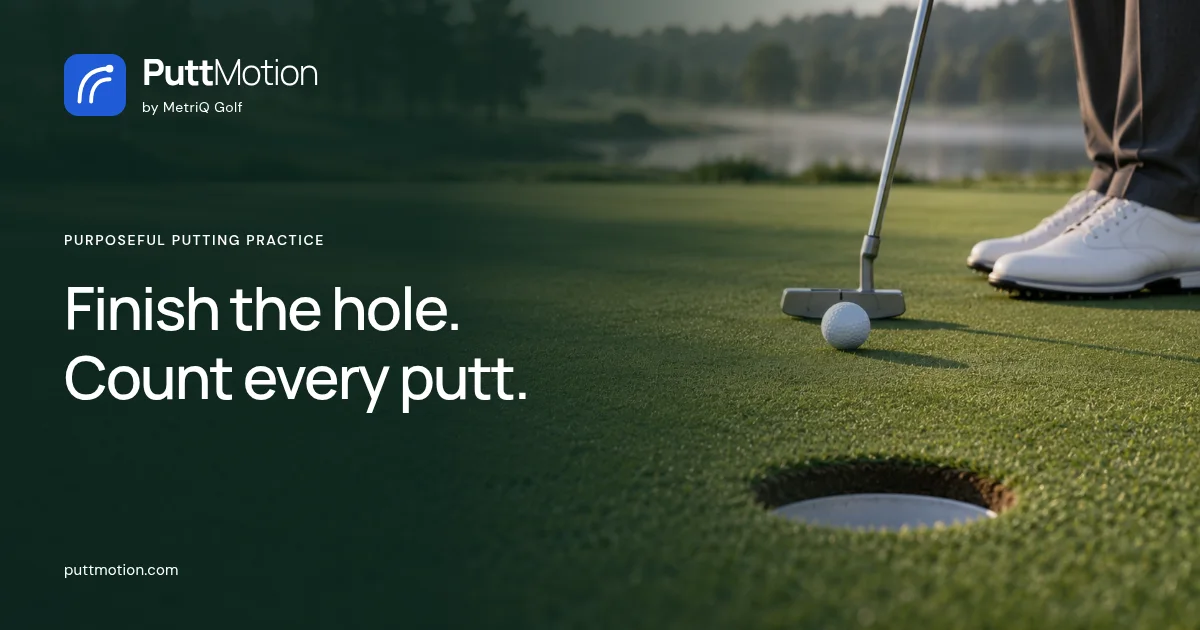
Watch the ball stop. Describe one thing you actually saw: it finished short, passed the hole on the low side, or went in. A missed putt alone cannot tell you that the face was open or that your stroke needs rebuilding.
Then prepare for the ball’s new position. Even a short second putt gets a read and an intention. After holing out, record the result and move to the next starting point. Avoid dragging another ball onto the old spot for a hurried correction during this part of practice.
This is a suggested way to rehearse the transition between putts. It does not require you to feel perfectly calm or pretend that a disappointing result did not matter.
Play a small circuit with one ball
On a quiet practice green, choose six starting positions: two around 3 ft, two around 6 ft and two around 9 ft. Include different lines if space allows, keep markers out of other players’ way and adapt the distances to your level. These are example distances, not a performance standard.
Make two laps of the circuit. Play one first putt from each position, then finish the hole before moving on. Use your chosen routine before every stroke, whether the previous ball went in or missed. You will have 12 first-putt attempts; your total number of strokes will depend on what happens afterward.
Write down the starting distance, whether the first putt went in and the total putts for that hole. If the first putt misses, add a separate note about your preparation for the second putt: did you follow your plan, skip a step or add one? If the first putt went in, there was no follow-up putt to assess. Paper is enough for this record.
Review the routine without hiding the score
A missed putt can follow the routine you chose. A holed putt can follow a rushed setup. Keep both observations rather than letting the result decide whether the preparation happened.
Look at the notes after both laps. Did you repeatedly skip choosing the pace after a miss? Did you add several rehearsals before a short second putt? Pick one of those behaviors to work on next time. If a miss pattern keeps returning, give it a separate technical or green-reading session, with a coach when useful.
For first-putt make rates, keep the starting distances separate and show makes alongside attempts. Do not fold follow-up putts into those first-putt figures. One short circuit also cannot establish that a routine has improved your putting under tournament pressure.
Where PuttMotion fits
PuttMotion is available on the App Store, with putting drills, camera analysis, green reading and round statistics. Use the practice tools to give preparation as much attention as the result. For the circuit above, keep routine notes on paper and give the putt after a miss the preparation you planned for it.
You can practice the circuit above with paper and observation. For your next session, give the putt after a miss the preparation you planned for it.
Sources and references
- Hasegawa, Miura and Fujii (2020) — Practice Motions Performed During Preperformance Preparation Drive the Actual Motion of Golf Putting ↗
- Davies, Cruickshank and Collins (2017) — This really IS what we do with the rest of the day! (university abstract; observational background) ↗
- Take PuttMotion to the green ↗