Play one ball until each practice hole is finished. Record the starting distance, the first-putt leave, the second-putt result and the total putts. Count second-putt conversions only among holes that actually needed a second putt, and retain the distances and conditions behind the result.
A putting training app can help you organize practice, but there is one useful habit you can start without an app: finish the hole. Play the first putt, measure what remains and putt out. Picking up a ball because it looks close replaces a result you can observe with an assumption.
Why I want the second putt in the picture
When I talk about purposeful practice with PuttMotion, I want the record to tell you what happened, not just whether the first putt looked good. A ball that stops near the hole has created another task. Its distance matters, but so do the slope and the direction from which you will play it.
This is not a reason to abandon repeated putts from one spot. Repetition is useful when you are working on a particular task. This session asks a different question: what happens when you complete each hole instead of grading the first putt alone?
A one-ball session you can actually finish
Use a practice green where you can move safely without crossing another player's line. Choose six starting positions around one available hole. For example, use two positions each at 10, 20 and 30 ft. Choose manageable slopes and write down the order before starting. Six holes and these distances are an illustrative format, not a validated training dose or a performance standard.
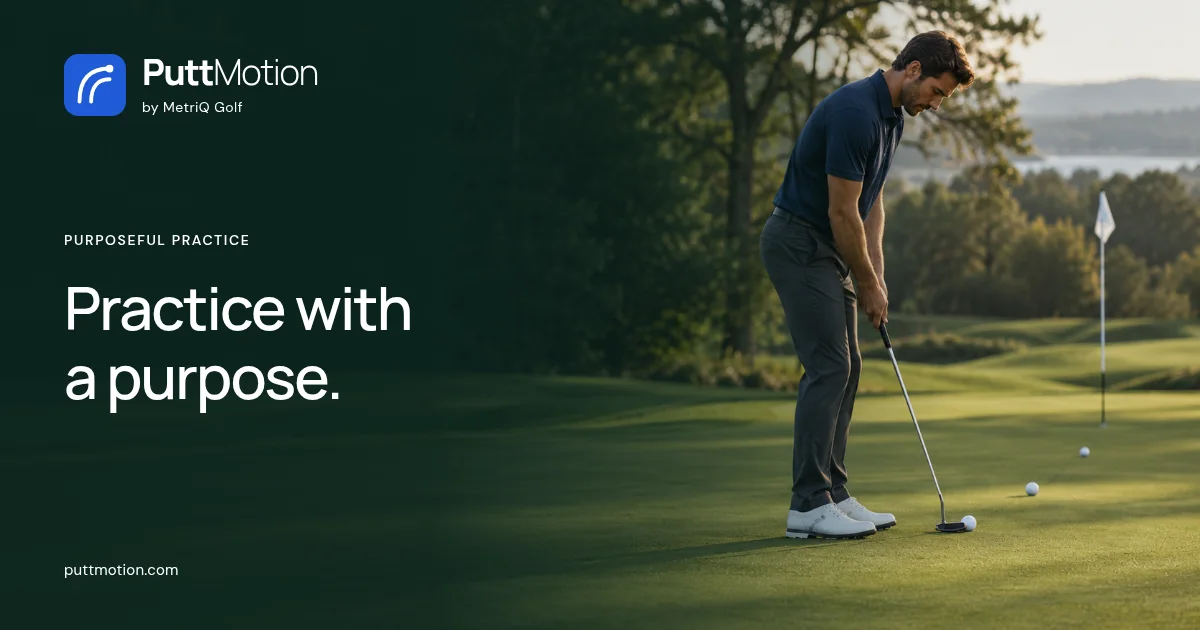
Play one ball from the first position with your normal routine. If you miss, record the distance left before playing again. Continue until the ball is holed, counting every putt. Then move to the next position. Do not take a second try from the original spot, give yourself a short putt or restart the session after a three-putt. Those choices would change the test.
The idea of completing the second putt also appears in the PGA of America's Two-Putt Zone Drill. The six-position format and record below are my suggested way to organize this particular session, not a reproduction of that drill.
Keep the sequence together
For each practice hole, write down the starting distance, the first putt's remaining distance, a simple description of the remaining putt, such as uphill or downhill, and the total putts needed to finish. If the first putt goes in, record zero remaining distance and one total putt. If it misses, record whether the very next putt goes in.
Here is a hypothetical six-hole session: one hole finished in one putt, four in two putts and one in three putts. That is 12 putts across six completed practice holes. Five holes needed a second putt; four of those second putts went in. Second-putt conversion is therefore 4 out of 5, or 80%, not 4 out of 6. The one-putt hole created no second-putt opportunity.
That 80% is only a description of five attempts in this session. It is not your established short-putt ability, and it says nothing about how difficult those five putts were unless you keep their distances and context.
Choose what to investigate rather than assigning blame
If a three-putt began with a first putt that left a long second putt, review that miss and the next putt separately. If it began with a short remaining putt, do not automatically blame concentration. A record of the outcome does not tell you the face angle, the quality of contact or what you were thinking.
Keep the first-putt leave beside the second-putt result. If one type of leave keeps creating trouble, bring that question to a coach or create a separate practice block for it. Keep that block's results apart from this completed-hole session. When repeating the session later, retain the starting positions where practical and note changed surface conditions.
Where PuttMotion fits
PuttMotion is available on the App Store, with putting drills, camera analysis, green reading and round statistics. Its practice tools fit the habit of recording the first putt and the challenge it leaves.
This exercise does not depend on an automatic second-putt report, which is not confirmed here. Use a simple note or scorecard now; use app fields only when their availability and meaning are confirmed. No automatic measurement of face angle or diagnosis of a miss is needed for this session.
The next time you practice, leave the spare balls in the bag for one short session. Finish each hole and keep the sequence. You will have a specific result to discuss instead of a collection of putts you assumed were close enough.