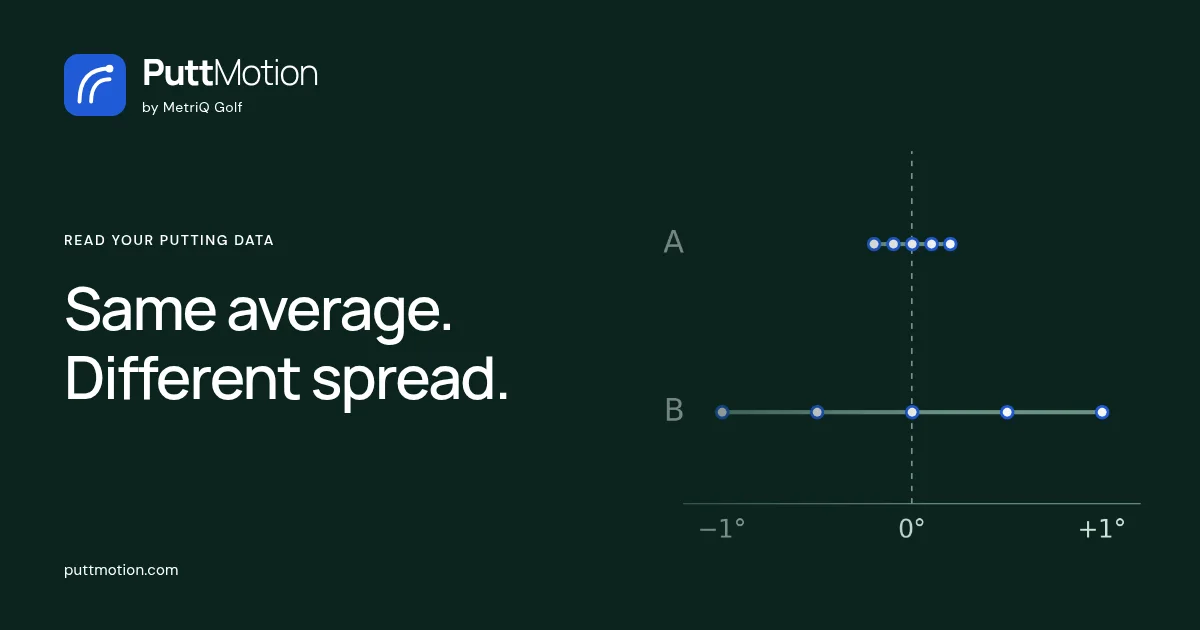
Strokes Gained compares the strokes used with a stated reference expectation for the starting situation. Identical two-putt counts can have different values, so check the reference, starting distance, putt sequence and completeness of the record before drawing conclusions.
If you are choosing a putting app to understand your rounds, look beyond the number of putts. Strokes Gained adds a reference to the result, so a two-putt from close range and a two-putt from a long distance do not have to receive the same evaluation. That is the kind of context I want PuttMotion to make easier to review.
PuttMotion is available on the App Store, with putting drills, camera analysis, green reading and round statistics. The website statistics previews use illustrative data, not player results. Check the official listing for current features and subscription details.
Start with the opportunity you had
Before judging a two-putt, ask where the first putt started. Strokes Gained compares strokes used with a reference expectation for that starting situation. Higher is better against the same reference; a negative number means strokes lost to it. The reference must be identified. A tour comparison and a different player-level comparison answer different questions. [1]
How two putts compare
Imagine two separate holes in a fictional round. On one, the first putt starts 6 ft away; on the other, it starts 30 ft away. The player takes two putts on each hole, and the ball stays on the green until holed. For this teaching example only, assign a fictional reference expectation of 1.5 strokes from 6 ft and 2.2 from 30 ft. These are invented values, not tour averages or PuttMotion benchmarks.
On the first hole, 1.5 minus 2 equals −0.5 strokes. On the second, 2.2 minus 2 equals +0.2 strokes. Across these two holes only, the total is −0.3 strokes. There is no field adjustment in this simplified example. It is not a round average, a forecast or a claim about a real golfer.
The scorecard contains two identical putting counts. The comparison does not. But even that comparison leaves a question open: how did each two-putt happen? A first putt left close followed by a tap-in and a first putt left far away followed by a long make can produce the same total. Keep the sequence if you want to discuss the next practice decision.
Read the report before changing your stroke
My practical suggestion is to take one round and write a short heading above its putting results: date, number of recorded holes, reference and whether the number is a total or an average per round. Keep starting distances and units consistent. If a distance is an estimate, retain that uncertainty rather than inventing precision.
Next, choose one hole whose number surprised you. Check the recorded start, the first miss and the next putt. Was the distance left observed? Was the ball on the green? Is anything missing? A putter used from off the green should not silently become an on-green putt; follow the report’s category definition. If the input is incomplete, resolve that before treating a calculated value as reliable.
Then describe what you saw without guessing the mechanism. “The first putt finished short and left a difficult second putt” is an observation. “My tempo caused the loss” needs evidence that the score alone does not provide. A Strokes Gained result cannot diagnose face angle, a misread or a technical fault.
Where PuttMotion fits
PuttMotion includes round records and putting Strokes Gained. Review the selected reference when interpreting the comparison, and check the official App Store listing for the current features and subscription details.
Keep repeated practice results separate from on-course rounds. Ten attempts at the same putt give you information about that task, but they are not ten independent tournament situations. If you want a practical starting point for recording practice, our guide to purposeful putting practice covers distance groups and miss patterns. [3]
A better question for your next review
Instead of asking only “How many putts did I take?”, ask “What did I do with the putting opportunities I faced, and what can I actually explain?” Keep the reference fixed when comparing results, look across a stated period and include the number of rounds. One good or bad day is still one day. PuttMotion is being built to support that clearer conversation, not to turn a number into a verdict on your stroke.
Sources and references
- Mark Broadie — Putts Gained Measuring Putting on the PGA TOUR (draft 13 January 2011) ↗
- Take PuttMotion to the green ↗
- PuttMotion — purposeful practice guide ↗