Choose one putting-practice question, keep starting distances separate and record makes, remaining distance and short or long misses. Use the pattern to choose your next exercise, compare like conditions and interpret Strokes Gained against a clear reference.
You can spend an hour working on your full swing and then finish with a few putts before leaving. The putting green gets whatever time is left, and the session ends with a feeling: good today, poor today, somewhere in between. The useful question is what that feeling tells you to practice next.
With PuttMotion, I want to give putting that same attention to detail. The starting point is simple: know the distance, record the result and look for a pattern you can work on. A clear practice question makes twenty minutes on the green more useful to review than a pile of balls hit without a plan.
PuttMotion is in prelaunch, with a standalone experience planned alongside its place within MetriQ. Putting drills, make percentage by distance, short and long miss analysis, putting Strokes Gained, slope-reading training and tempo training are part of its scope. Here is a practical way to think about the practice those tools are meant to support.
Start with one question
Choose a question you can answer during one session. Are you leaving longer putts short? Does your start line hold up on short putts? Does your distance control change when you stop hitting the same putt repeatedly? These questions lead to different exercises.
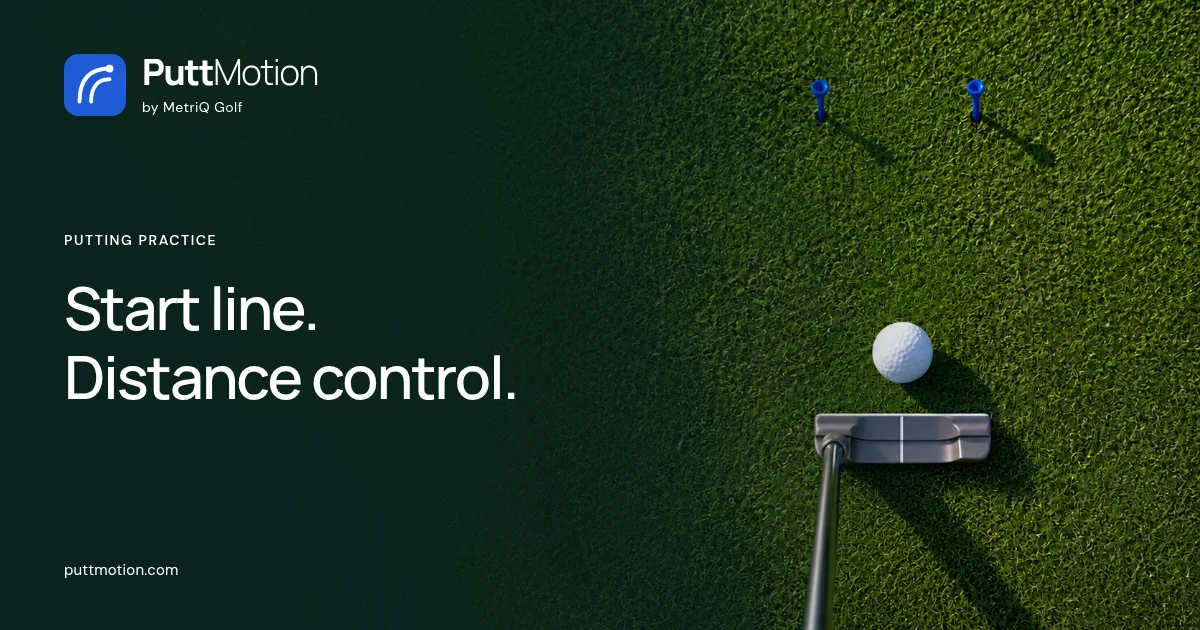
For this session, use a distance-control question: can you finish longer putts near the hole without repeatedly leaving the ball short? Find a safe area of the practice green, choose a hole and mark three starting distances. For example, use 10, 20 and 30 ft. These are illustrative practice distances, not performance standards. Adjust them to your experience and the space available.
Keep the first test as comparable as possible: use the same hole and broadly the same line. Note whether the putt is uphill, downhill or across a slope. A change of slope or green speed can explain a different result without any change in your stroke.
Keep distance groups separate
Hit ten putts from each starting distance, taking your usual routine before every ball. Record the starting distance, whether the ball went in, the distance remaining and, for misses, whether it finished short or beyond the hole. Mark left and right separately when useful. For a side miss, use the straight line from the starting point to the hole as your reference for short or long. If the result is unclear, record it separately.
Make percentage is holed putts divided by attempts in the same distance group, multiplied by 100. In an illustrative session, eight holed putts from ten attempts is 80%; three from ten is 30%; one from ten is 10%. Combining them gives 12 from 30, or 40%, but that total hides the difference between the distances.
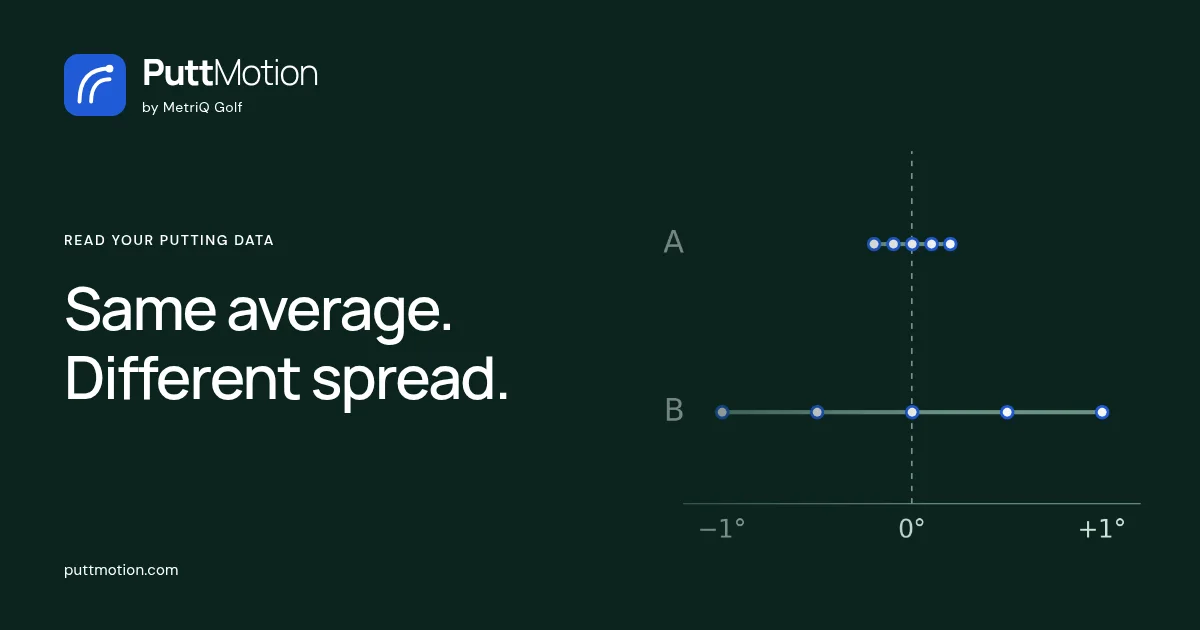
Small samples move quickly. One more holed putt changes a ten-attempt group by ten percentage points. Treat the result as a starting observation. Repeat the same test on another day before deciding that a single session reveals a lasting strength or weakness.
Read what happens after the miss
From longer distances, a make percentage alone leaves out a lot. Two sessions can have the same number of holed putts while leaving very different next putts. Look at the distance remaining as well as the direction of the miss.
Suppose six of nine misses in a ten-putt group finish short. For a percentage of misses, use nine as the denominator, not all ten attempts. If most stop close, the practical priority may be different from a group that repeatedly finishes several ft short. Keep the count and the remaining distance together.
Short misses do not prove that your stroke needs more force. The read, slope, contact and chosen pace can all contribute. Use the pattern to choose a test: repeat on a flatter line, check strike with a coach or change your intended finishing zone. PuttMotion's short and long miss analysis belongs in that conversation, alongside what you actually saw on the green.
Turn the pattern into a short practice block
Try this suggested twenty-minute structure. Spend three minutes getting a feel for the green. Use eight minutes for a baseline of five putts from each of your three distances. Spend six minutes on the distance that created the least manageable next putts. Finish with three minutes alternating distances, playing one ball at a time. The timing is a guide; keep a complete routine rather than rushing to meet a count.
During the focused block, choose a finishing zone around the hole that fits your level. Record whether the ball finishes inside it, including holed putts. Keep that zone unchanged within the comparison. A wide zone makes the task easier, so a percentage without the zone size tells an incomplete story.
For the final block, change the distance after every attempt. You now have to judge a fresh putt instead of making small corrections to the one you just hit. Keep this result separate from the repeated-distance test. They ask different questions.
Use Strokes Gained with a clear reference
Putting Strokes Gained adds a benchmark to the result. In its usual form, the value of a putt is the expected strokes to finish from the starting position, minus the stroke just used, minus the expected strokes remaining. A holed putt has zero strokes remaining.
The reference matters. A comparison with a tour benchmark answers a different question from a comparison with players at another level. Before interpreting a PuttMotion putting Strokes Gained result, check which benchmark and distance data are being used. Do not turn a drill score into a claim about tournament performance; repeated practice and on-course putting have different conditions.
Leave with a decision you can repeat
Finish by writing one sentence: next time, I will repeat this distance and this exercise because this was my miss pattern. Keep the session conditions with the result, then compare like with like when you return.
That is the role I want PuttMotion to play: helping you connect putting practice, an understandable result and the next useful exercise. The standalone experience is coming soon. Until then, take a ball, a few markers and one clear question to the green. Give your putting a planned place in the session.
Sources and references
- Trackman — Performance Putting The Evaluator ↗
- PGA of America — How to Practice Golf at Home Part 1 ↗
- Mark Broadie — Assessing Golfer Performance Using Golfmetrics ↗