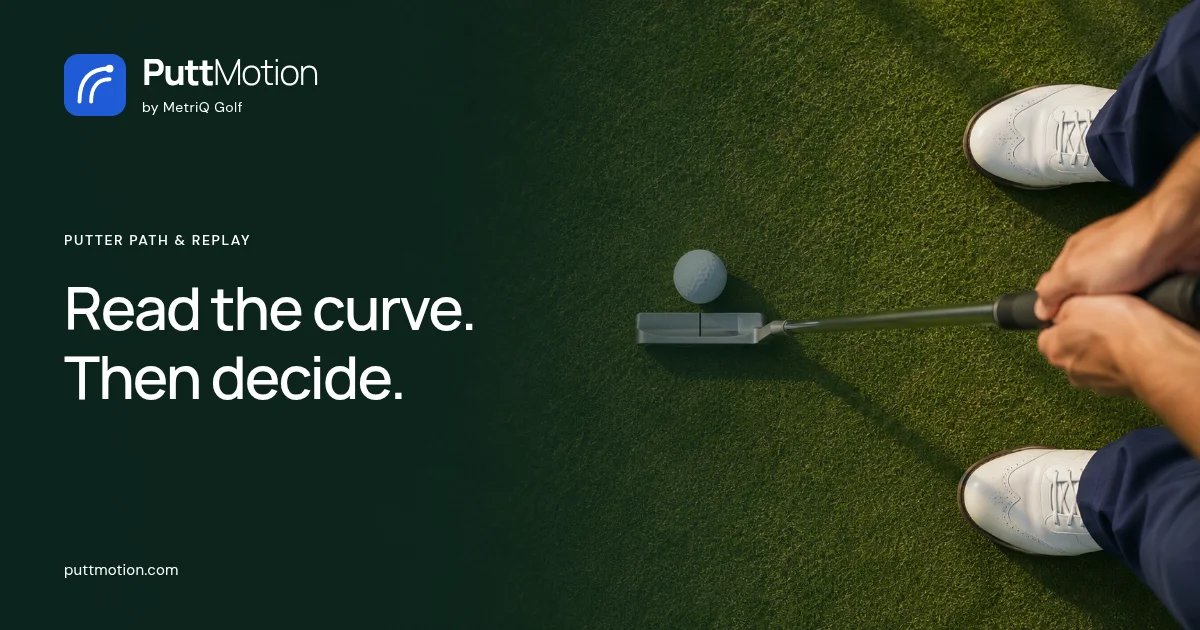
A curved putter trace alone does not tell you to rebuild your stroke. Separate the overall shape from the putter’s direction near impact, face orientation and the ball’s start direction. Compare repeated attempts against the same reference before deciding what to change.
The shape of the whole trace and the direction of the putter as it meets the ball are different observations. Face angle and the ball’s start line answer still other questions. Use the replay to tell those apart before you change the stroke.
What is the difference between the path’s shape and impact?
Imagine looking down at a gently curved road. The road’s overall shape is one thing; the direction a car is traveling at one point is another. A putter trace has the same distinction. A curve away from the ball does not tell you the direction the head is moving when it reaches the ball.
The face adds another piece of information. Its orientation is not automatically the same as the direction of travel. And a still image at address does not show how the face arrives at impact. Review the movement before trying to straighten it.
Research by Karlsen, Smith and Nilsson examined 1,301 putts from about 13 ft by 71 elite players. In that analysis, face angle at impact had greater estimated importance for stroke-direction consistency than putter-path direction at impact. This does not establish an ideal path for every golfer or make path irrelevant. It is a reason to avoid judging a stroke from its outline alone. Read the study.
What can PuttMotion’s replay show?
PuttMotion presents overhead camera analysis with replay, putter path and face orientation. Keep those views connected: inspect the movement, then look at the relevant readout. A traced curve is not a diagnosis of your shoulders, wrists or posture.
Use the app’s positioning guidance and keep the phone stable above the ball. Before comparing attempts, check that the reference line and camera position have not changed. If you cannot identify the moment or reference a number describes, leave that comparison open rather than guessing.
What should I review before changing anything?
Choose a manageable putt on a reasonably flat practice surface. Keep the starting point, target, ball and putter the same. Decide your intended start line before the stroke. This is an observation exercise, not a validated training protocol or a test of the app’s measurement accuracy.
- Record a short set with your normal stroke. For example, six attempts are enough to start a discussion, not to establish a reliable performance level. Record all six results, including misses.
- Review each usable replay. Note the overall path shape separately from what you can observe near impact. Compare the face and the ball’s initial direction against the same intended line.
- Add the outcome: holed, or distance left and side of the miss. If a replay is unclear, mark it unclear. Keep its ball result in the set, including misses.
- Look for a repeated mismatch worth investigating. Bring the replays and results to your coach before changing several parts of the stroke at once.
Suppose, hypothetically, that all six traces look gently curved. Five balls appear to start on the intended line and one starts right. That observation does not show that the curve caused the miss. Review what was different on that attempt, including aim and delivery; acknowledge anything you did not measure.
What question should the evidence suggest next?
If the ball repeatedly starts where intended but misses the hole, consider the read and pace as well as the strike. If initial direction varies, inspect the reference, face delivery and contact with your coach. The final resting position alone cannot tell you which of these changed.
Do not force every stroke into a perfectly straight drawing just to make the screen look cleaner. Equally, do not declare a curve harmless because it looks smooth. Use repeated, comparable attempts to decide whether the pattern deserves attention.
That is how I want PuttMotion to fit into daily practice: make the movement visible, connect it to what the ball did and leave the session with a specific question. Explore the putting app and use your next replay to understand your stroke before you redesign it.
Frequently asked questions
Does a curved trace mean my stroke is wrong?
No. A curve away from the ball does not tell you the direction the putter head is moving when it reaches the ball. Compare repeated attempts against the same reference before you decide what to change.
What should I separate in the replay?
Keep the overall shape apart from the putter’s direction near impact, the face orientation and the ball’s start direction. A traced curve is not a diagnosis of your shoulders, wrists or posture.
What did Karlsen, Smith and Nilsson find?
In 1,301 putts from about 13 ft by 71 elite players, face angle at impact had greater estimated importance for direction consistency than putter-path direction at impact. That is a reason not to judge a stroke from its outline alone. It does not set an ideal path for every golfer.
Sources and references
- Karlsen, Smith and Nilsson (2008) — The stroke has only a minor influence on direction consistency in golf putting among elite players ↗
- PuttMotion — Overhead putting analysis, replay and graphs ↗
- Apple — PuttMotion Golf on the App Store ↗