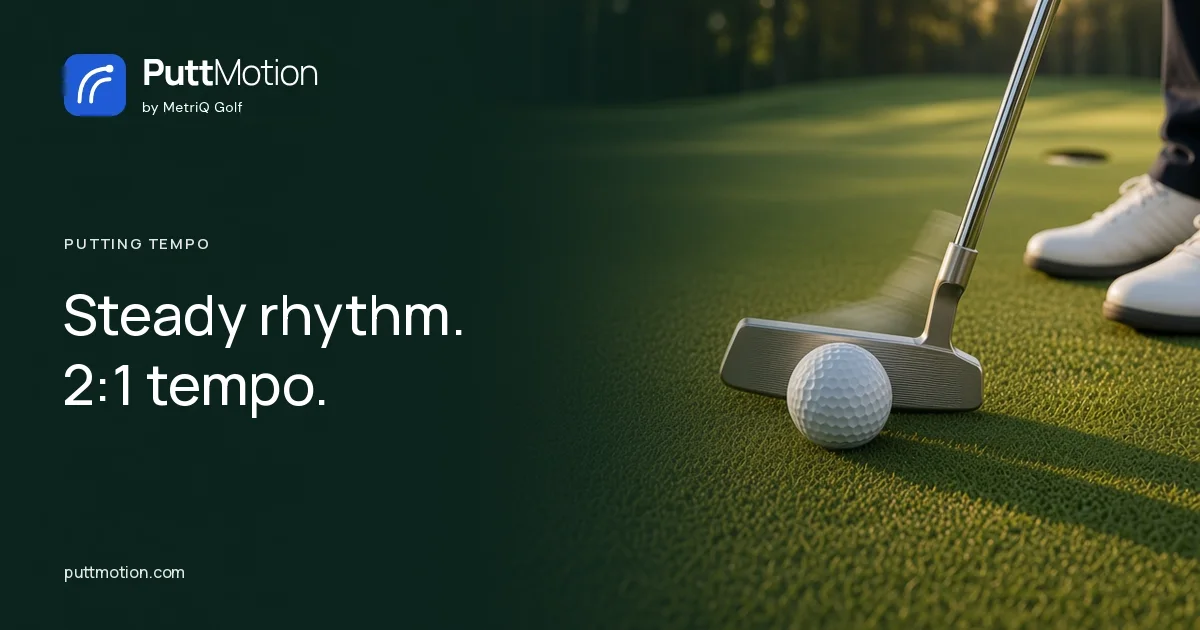
There is no single "correct" putting tempo. What measured tour players share is a ratio: in a sample of 99 PGA Tour players, the backstroke took on average about 2.1 times as long as the forward stroke to impact, even though their overall speeds varied widely. A good putting tempo is one you can repeat, with roughly that 2:1 shape, and that stays the same while the stroke gets longer on longer putts.
What does "putting tempo" actually mean?
People use "tempo" for two different things, and it helps to separate them:
- Pace of the stroke: how long the whole motion takes, in fractions of a second. This varies a lot from player to player.
- Ratio (rhythm): how long the backstroke takes compared with the forward stroke to impact. This is the "2:1" people talk about.
Christian Marquardt, who reported the SAM PuttLab tour data, makes the same point: two players can share the same ratio while having very different stroke speeds (Marquardt, 2007).
Where does the 2:1 putting ratio come from?
From measurement. The SAM PuttLab study recorded seven consecutive putts from each of 99 PGA Tour players on a straight, level putt of about 4 m (13 ft) at nine tour events between 2003 and 2005. The group averages (Marquardt, 2007):
| Measure (99 tour players) | Group average | Spread between players (SD) | Typical variation within a player |
|---|---|---|---|
| Backswing time | 670 ms | 90 ms | 30 ms |
| Time from start of the forward stroke to impact | 317 ms | 35 ms | 11 ms |
| Ratio (backswing time ÷ time to impact) | 2.1 | 0.29 | 0.11 |
Two details from the same paper matter for amateurs:
- Speed differs, ratio doesn't so much. The paper cites Tiger Woods at a ratio of 2.2 with a 660 ms backswing, and Loren Roberts at the same 2.2 with a 977 ms backswing. Same shape, very different pace.
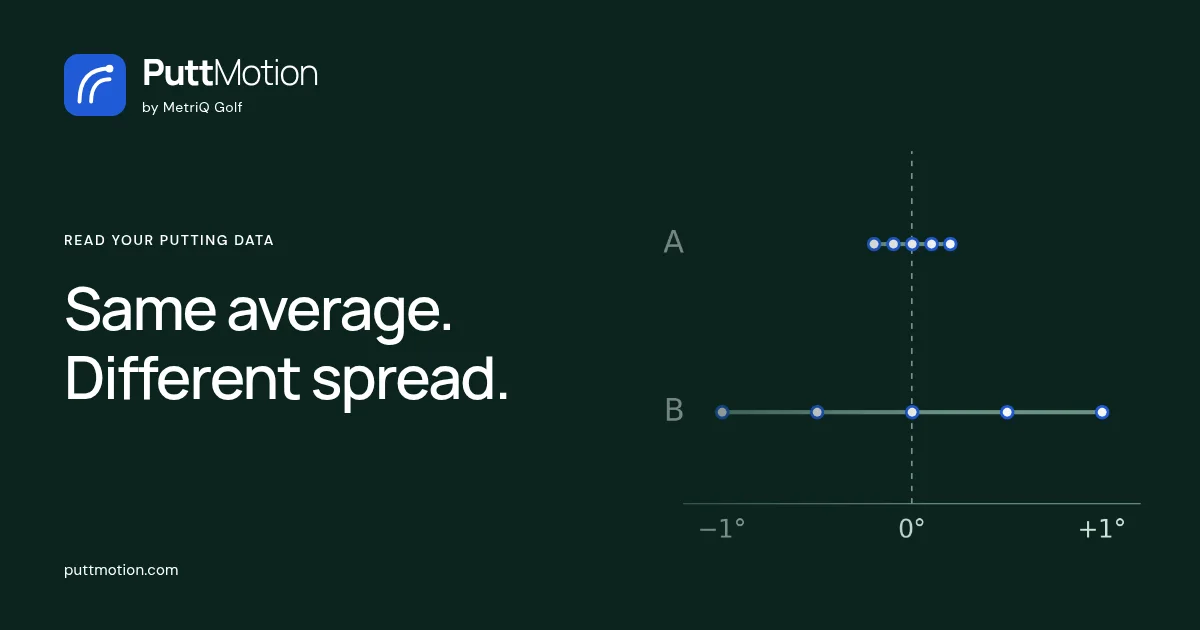
- Each player was very consistent with himself. The variation within a player (11 ms for time to impact) was far smaller than the difference between players (35 ms). Repeatability stood out more than any single "ideal" number.
Physicist Robert Grober of Yale offered one explanation: the strokes of accomplished putters behave like a pendulum driven in resonance, and when the backward and forward forces are balanced, the backstroke-to-downstroke ratio comes out at about 2:1 (Grober, 2009; Grober, 2011). That is a physical model, not a rule you have to follow.
Should my putting tempo change on longer putts?
The idea behind a steady tempo is that you control distance with the length of the stroke, not by speeding up. In Grober's model, accomplished golfers keep the duration of the downswing roughly constant whatever the putt length, so a longer putt simply needs a longer stroke (Grober, 2011). He presents parts of this as hypotheses to test, and the SAM data above come from a single putt length, so treat "same tempo at every distance" as a well-supported practice goal rather than a proven law.
If your long putts often come up short or race past, a tempo that speeds up or slows down with distance is one possible reason. Putter speed and contact also matter; What putter speed tells you about distance control covers that side.
What BPM should I set on a putting metronome?
There is no published "right" BPM, and metronome apps don't all count beats the same way. Grober suggests a simple count: "1" at the start of the backstroke, "3" at the top and "4" at impact, which gives a 2:1 ratio when the counts are even (Grober, 2011). In that count, one beat equals the time of the forward stroke to impact.
My own arithmetic from the published numbers, as an illustration only:
- Tour group average: 317 ms per beat ≈ 190 beats per minute.
- Woods (660 ms backswing at 2.2): about 300 ms per beat ≈ 200 beats per minute.
- Roberts (977 ms backswing at 2.2): about 444 ms per beat ≈ 135 beats per minute.
The spread is the point. Start with a cadence that feels natural to you, then keep it.
How do I find and test my own putting tempo?
This is a practice suggestion, not a protocol from a study:
- Find your natural cadence. Make some practice strokes with no ball. On a metronome, adjust the cadence until it matches what feels natural; don't chase someone else's number.
- Putt three distances on the same beat. Five putts from 3 ft, five from 6 ft and five from 9 ft, keeping the cadence identical and changing only the length of the stroke.
- Check what actually happened. A metronome tells you the rhythm you're aiming for; a camera tells you whether you kept it. Compare the tempo reading across the three distances.
- Change one thing at a time. If the tempo drifts on the longer putts, repeat the block before changing anything else.
Hypothetical example for illustration, not a real player or a real session:
| Distance | Putts | Tempo ratio (average) |
|---|---|---|
| 3 ft | 5 | 2.0 |
| 6 ft | 5 | 2.1 |
| 9 ft | 5 | 1.6 |
In this made-up example, the ratio holds on the short putts and drops on the 9-footers, which suggests the backstroke gets rushed when the putt gets longer. Fifteen putts is a small sample, so the next step would be to repeat the block on another day before drawing a conclusion.
Can I use a putting metronome during a round?
Not with audio. Rule 4.3a(4) of the Rules of Golf does not allow listening to music or other audio "to help with swing tempo" during a round (R&A, Rule 4). Build the rhythm in practice and take the feel to the course. Check your competition's rules before using any device.
How does PuttMotion help with putting tempo?
I built PuttMotion as a putting app for iPhone that works as a launch monitor for your putter. For tempo work, these are the parts that matter:
- Time Putt, the putting metronome, is always free. It gives you a visual guide for the backstroke, forward stroke and pause so you can repeat a cadence. More on the putting metronome app page.
- Camera analysis: recording starts by itself, with no button to press. It measures putter face and path, backswing, downswing and follow-through length, speed, tempo and the ball's start line, with replay and charts. See the putting launch monitor app.
- Simulator and drills: the simulator shows whether the putt would have dropped, and many drills use it, including Money Zone, Ladder, Gate, Lag, Tour Zone and a start-line challenge. See the putting drills app.
- Focus tools: breathing, eye tracking and gaze fixation for your pre-putt routine. Give your eyes a clear job before the putt explains the gaze part.
- Rounds and stats: log rounds putt by putt and see your make rate by distance and strokes gained putting.
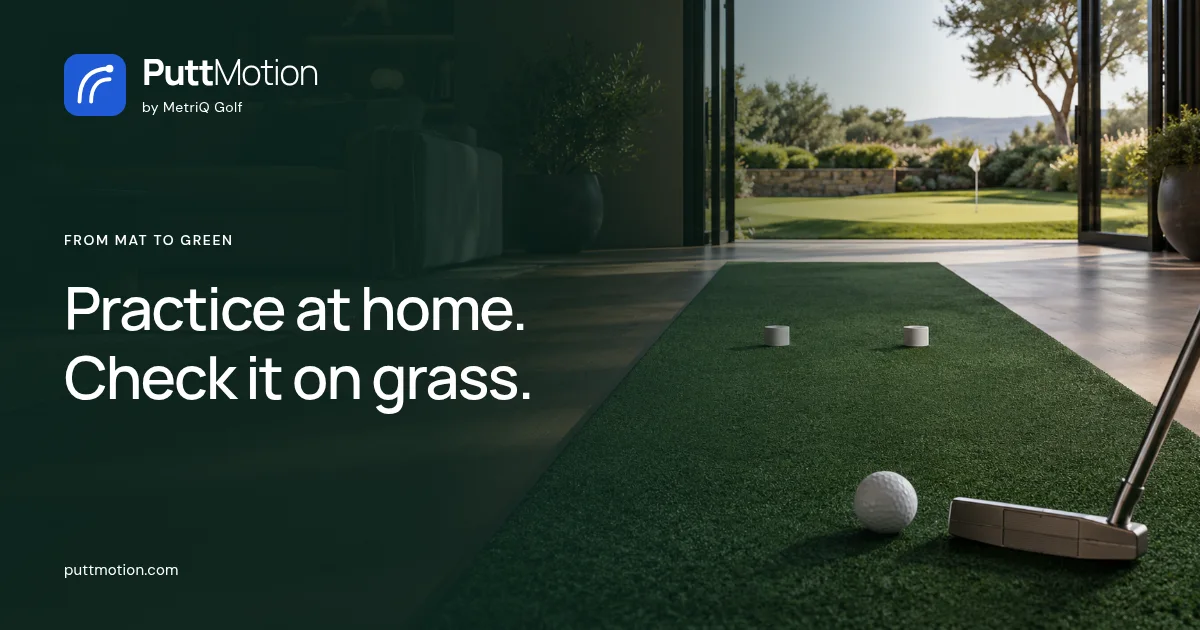
Practicing indoors? Practice putting at home covers the setup. On the course, green reading with LiDAR works on iPhone Pro models, for practice.
PuttMotion is free to download. Time Putt is always free; the other features can be used for free a few times before PuttMotion Pro is required. On the US App Store, PuttMotion Pro costs US$39.99 per year or US$5.90 per month (checked November 24, 2026). PuttMotion runs on iPhone with iOS 15.1 or later.
Frequently asked questions
What is a good putting tempo?
One you can repeat. Measured tour players averaged a backstroke about 2.1 times as long as the forward stroke to impact, but their overall speed varied widely. Aim for a roughly 2:1 shape at a pace that feels natural, and keep it at every distance.
Is the 2:1 putting tempo ratio proven?
It is an observed average, not a rule. In the SAM PuttLab sample of 99 PGA Tour players, the average ratio was 2.1 with a spread of 0.29 between players. A physics model by Robert Grober explains why a balanced, pendulum-like stroke tends toward about 2:1.
What BPM should I use for a putting metronome?
There is no single right number. Using Grober's 1-2-3-4 count, the tour average works out to about 190 beats per minute, but individual players ranged from roughly 135 to 200 in the examples in the study. Start with a cadence that feels natural.
Should the tempo be the same on long and short putts?
That is the usual goal: keep the rhythm and change the length of the stroke. Grober's model describes accomplished golfers keeping downswing time roughly constant across putt lengths.
Can I use a metronome during a round?
Not audio. Rule 4.3a(4) does not allow listening to audio to help with swing tempo during a round. Use it in practice.
Is PuttMotion's putting metronome free?
Yes. Time Putt is always free. Camera analysis, drills, green reading and stats are part of PuttMotion Pro and can be used for free a few times first.
Sources and references
- Marquardt, C. (2007). The SAM PuttLab: Concept and PGA Tour Data. Annual Review of Golf Coaching 2007, pp. 101–114. PDF (accessed November 24, 2026). ↗
- Grober, R. D. (2009). Resonance in Putting. arXiv:0903.1762. arxiv.org/abs/0903.1762 ↗
- Grober, R. D. (2011). Resonance as a Means of Distance Control in Putting. arXiv:1103.2827. arxiv.org/abs/1103.2827 ↗
- The R&A, Rules of Golf, Rule 4.3a(4) (audio and video). randa.org (accessed November 24, 2026). ↗
- PuttMotion Golf on the US App Store, prices and requirements. apps.apple.com (checked November 24, 2026). ↗
PuttMotion features: confirmed by the developer, MetriQ Golf, on November 20, 2026.